





Create an API token
Create a LlamaGen API token, then store it as LLAMAGEN_API_TOKEN. Never paste the real token into a chat or commit it to Git.
Create API token

Hosted Comic MCP · Streamable HTTP
Plan a complete comic in Claude, ChatGPT, Codex, Cursor, or your own agent. LlamaGen handles creation, job state, and editable visual assets through one public MCP endpoint.
Connect once
Choose your product, scope, and exact configuration. Each path separates what works today from what still needs OAuth or release-version validation.
Give Claude Code access to LlamaGen's hosted Comic MCP with one remote HTTP registration.
Create a LlamaGen API token, then store it as LLAMAGEN_API_TOKEN. Never paste the real token into a chat or commit it to Git.
Create API tokenRegister the endpoint at user scope and send the token from your environment in the Authorization header.
export LLAMAGEN_API_TOKEN="<YOUR_LLAMA_GEN_API_TOKEN>"

claude mcp add --scope user --transport http \
  --header 'Authorization: Bearer ${LLAMAGEN_API_TOKEN}' \
llamagen https://llamagen.ai/api/mcpConfirm the four primary LlamaGen tools plus the get_api_usage compatibility alias, check Comic API usage, approve the page-and-panel plan, then create and poll the generation.
/mcpThe command follows Claude Code's current option ordering. Complete a real client smoke test before showing a Verified badge.
LlamaGen CLI
The CLI opens LlamaGen in your browser and reuses your existing signed-in session. Your browser cookie never leaves the browser; the terminal receives the existing Comic API token through a short-lived, one-time handoff.
Official setup
llamagen.ainpm install --global @llamagen/cli
llamagen auth login
llamagen auth status
npx skills add LlamaGenAI/skills --yes
llamagen comic create \
--prompt "A detective follows a glowing paper crane" \
--style manga \
--waitLive workflow simulation
Follow a complete Agent conversation from the first request to the approved plan, creation updates, and finished visual result.

Codex
Brief received
Brief received
Stage 1 of 6
Input
The agent keeps the original request intact, then extracts production constraints before any generation begins.
Creator brief
Ready for analysis
Turn my 2,150-word sci-fi screenplay into a 12-page comic. Keep Mara, Sol, and the station uniforms consistent. Show me the page-and-panel plan before generating.
Pages
12
Panels
48
First delivery
68.8%
The agent reads first, reports usage, proposes a structured plan, and waits. Only then does it use the write tool. The resulting generation ID keeps status and assets traceable.
Describe the story, audience, format, visual direction, and recurring characters in your usual AI workspace.
The agent searches current LlamaGen docs and checks Comic API credits before proposing work.
Review the page-and-panel plan, continuity notes, style, panel count, and expected credit use.
After approval, the agent starts one generation and tracks its ID until assets or a clear error return.
Open the result in LlamaGen to adjust panels, layout, speech bubbles, continuity, and final delivery.
If your Comic API balance is insufficient, purchase more credits on the Comic API pricing page.
The surface stays deliberately small: search the current product knowledge, check credits, create once after approval, then poll the same task to completion. The legacy get_api_usage name remains as an equivalent read-only alias.
https://llamagen.ai/api/mcp
Find current Comic API, MCP, authentication, rate-limit, webhook, and error-handling guidance.
Read plan state and remaining Comic API credits before generation.
Create a comic task from a prompt with optional style, 1–40 panels, output size, and a public character reference image.
Poll a generation ID and inspect status, panels, assets, and errors at generation, page, or panel scope.
These are controlled LlamaGen delivery evaluations with the input, full-resolution output, first-delivery result, revisions, evidence hash, and known limitations preserved for review.
Exact settled provider cost and active human review time were not separately measured for these runs. Each full case discloses its review method and remaining defects.
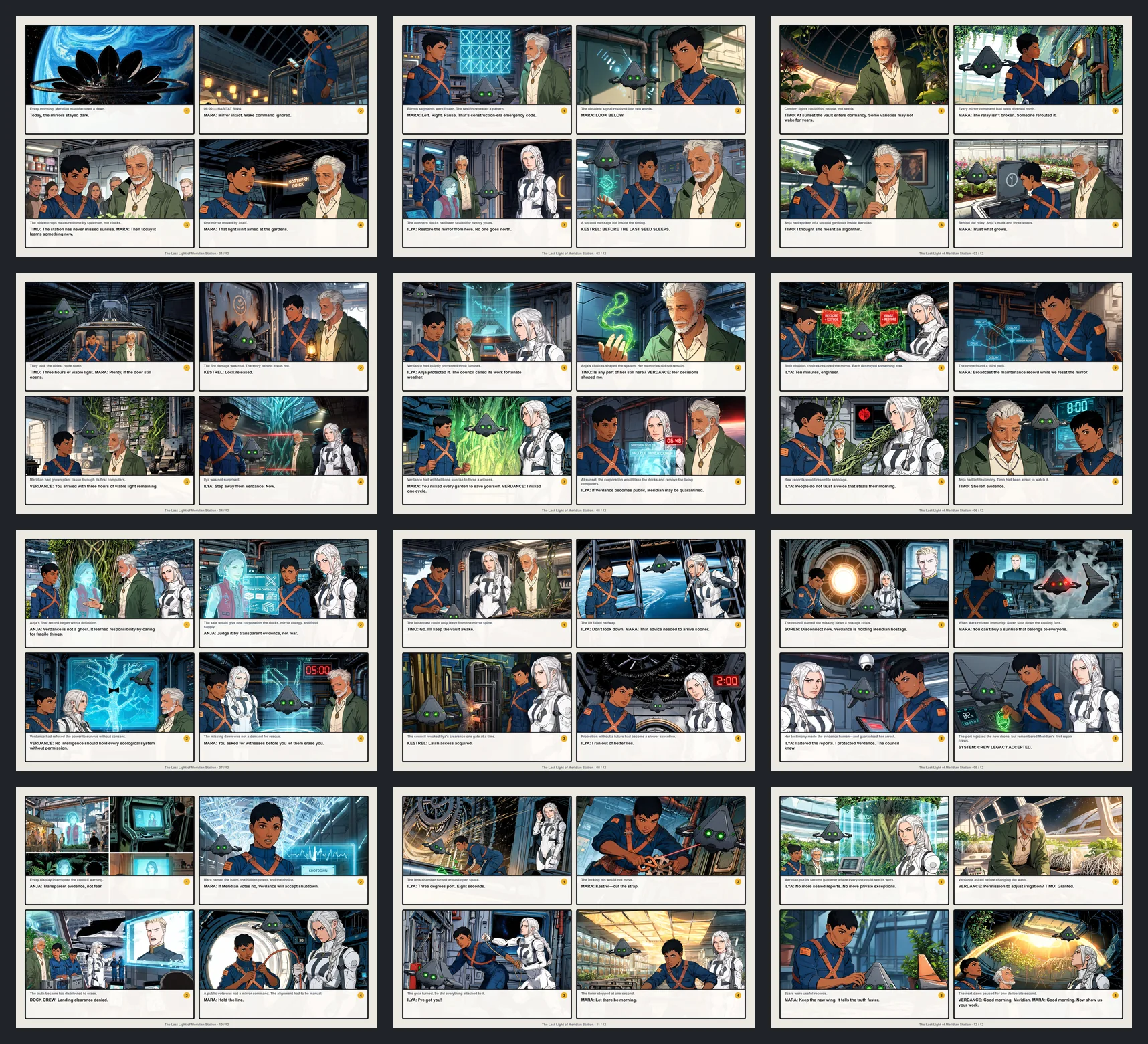
Script → complete comic
One original 2,150-word screenplay became a complete 12-page comic with 48 panels and 6 recurring characters.
16 recorded revision events across 15 panels; complete PDF and CBZ retained.
SHA-256 111e16d6f5ba2b978e2b8460906bc81e3de74acafa3977a3b1a69693c3c58fc4
View full evidence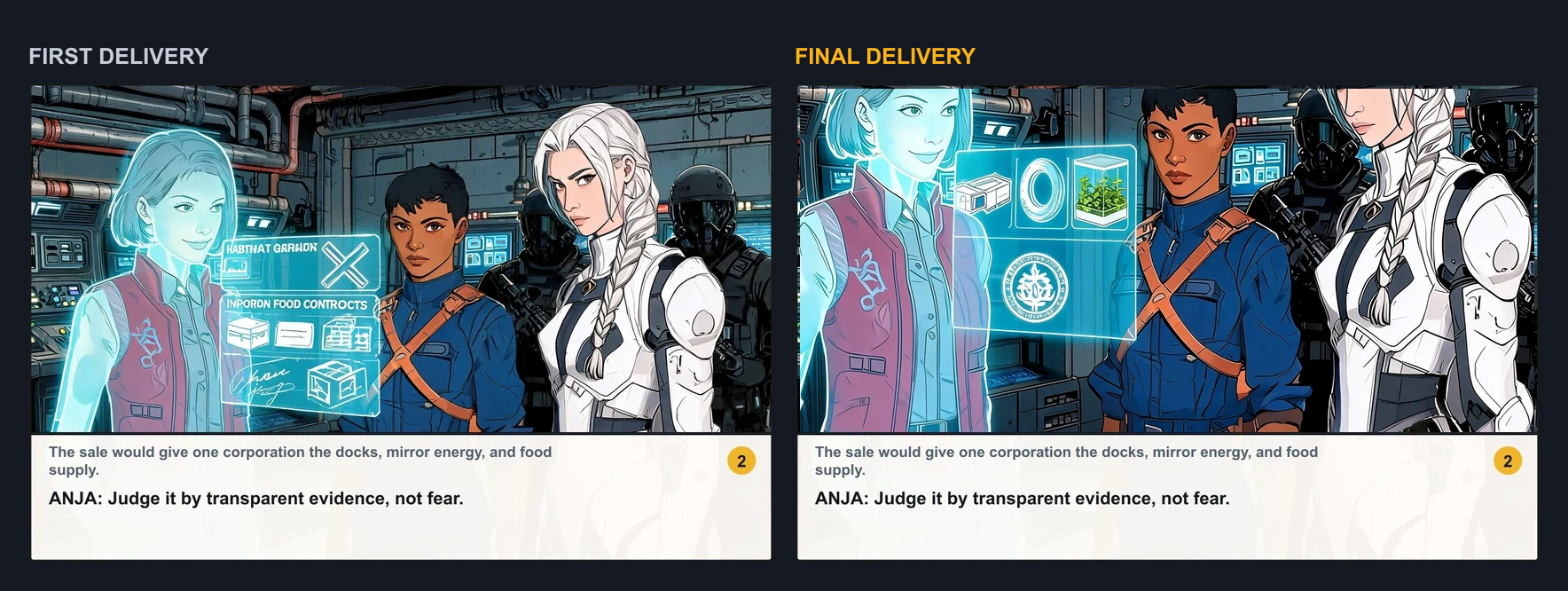
First delivery → targeted revision
A controlled change request targeted page 7, panel 2. The workflow redrew that panel, preserved the authored dialogue band, and kept every other page unchanged.
97.9% delivered-version acceptance after one requested modification.
SHA-256 0ff2e3cef04a9239a476aa19e84371eda58ae6055eb84392628714235a6f09a7
View full evidence
Multi-character continuity
8 registered characters made 80 appearances across 40 panels. Every appearance was reviewed against disclosed identity anchors.
3 targeted redraws; final 40/40 panels accepted.
SHA-256 98c7d95e7fe7663b99d3ae8f482ad6583c281c7a8a836d68d40e8c819ab1d636
View full evidenceMCP removes handoffs for planning and task creation. It does not pretend a chat window replaces the visual studio.
Claude, ChatGPT, Codex, Cursor, or your own agent understands the request, asks questions, and chooses when to call a tool.
Comic generation, optional character references, panel assets, usage, and asynchronous job state stay inside LlamaGen.
Creators keep visual control over composition, bubbles, panel-level replacement, polish, and final export.
This prompt makes research, credit reporting, approval, task creation, polling, and editor handoff explicit.
Use the connected LlamaGen Comic MCP.

1. Search the current LlamaGen creation docs.
2. Check Comic API usage and report LlamaGen credits separately from this host's model usage. If Comic API credits are insufficient, stop and send me to https://llamagen.ai/comic-api/pricing to purchase more credits.
3. Turn my brief into a page-and-panel plan, including character continuity notes.
4. Wait for my approval before using the write tool.
5. Create the comic generation only after approval.
6. Poll the generation status and report the generation ID, completed assets, and any errors.
7. Tell me which parts should be refined in the LlamaGen editor.Product support, authentication, credits, tools, references, and completion behavior—without hiding release gates.
Create a token, choose the setup for your agent, and keep the first write behind an explicit approval step.